Monday, July 15, 2013

Day 6 - Les Andelys and Chateau Gaillard


Today we woke early as the ship left the dock at Rouen and headed back toward Paris..  We cruised the Seine and sat on the  sun deck to enjoy the slightly overcast morning and the lovely breeze.We arrived at Les Andelys which is a  small town along the Seine at the base of limestone cliffs and the ruins of Chateau Gaillard.  The castle was built in 1196 by Richard the Lionheart.  Richard was not only  the King of England, he was also the Duke of Normandy.  He built the castle fortress to block the king of France from reaching Rouen by the river.  King Phillippe did not attempt to cross Richard in his lifetime, but when Richard's brother, John, became King of England, King Phillippe took his chance.


King Phillippe sent his French troops to siege the castle which caused the residents of the town of Les Andelys to flee to the castle for protection.  The castle was built to survive a siege and might have outlasted the French troops except for one very clever soldier.  The soldier climbed into castle through a latrine chute that gave him access to the chapel.  Yes, you are correct in your belief that a latrine chute was a "toilet." :)  That soldier was followed by several other soldiers that ambushed the castle guards and opened the drawbridge which brought the siege to an end.


After visiting Les Andelys (above), we continued along the Seine River.  We passed many small towns throughout the day including Le Chateau des Tourelles which is pictured below.  This is the last remaining medieval castle fortification.  It was used as a rolling mill and tannery until the 18th century.This evening was the captain's dinner - lots of great food!  There is dancing tonight, so I will watch for a bit and play the game to guess how many people will dance to the songs.  I wonder if my powers of observation work on dancers! :)We have an early morning tomorrow because we are traveling to the Palace of Versailles!


Day 5 - Normandy Beaches

Today we had an early start because the Normandy beaches are a two hour bus ride from the ship still docked at Rouen.Our first stop was the D-Day Museum where we viewed a World War II video produced by the Ministry of War showing how the Allies prepared for the D-Day invasion.  The video showed how the American and English governments made plans for the invasion.  The Germans knew that any invasion of the French coast would require control of a major harbor port to continue to supply the invading forces.The Allies' solution to this was to begin construction of a floating harbor in pieces.  Laborers throughout England were commissioned to construct pieces of the harbor without knowledge of what they were constructing or its purpose.  The pieces were launched and assembled on location after the initial invasion.  They sank old ships to create an ocean break and then pieced together the many pieces to create a floating steel harbor that was supplying the Allied Forces within days of the D-Day invasion and was completed in less than two weeks.  The floating harbor was established in Arromanches along the Normandy coastline.


We then got back onto the bus and drove further along the coast to view the only remaining intact German gun and bunker on the Normandy coast.  They were mostly destroyed after the war when the guns were melted down for reconstruction and the bunkers were filled in with cement and abandoned.  The German guns and bunkers were located 300 yards from the shore to hide them from incoming ships.   Below, Laura and I are standing in front of the wildflower fields between the bunkers and the shore.  The other picture is of Laura in front of the destroyed German gun and bunker.  Pieces of the gun were found scattered several yards from the entrance of the bunker.


Our next stop was the American Military Cemetery at Omaha Beach.  There was a small moment during which the National Anthem and Taps were played and we were given roses to place on plots throughout the grounds.  The cemetery land was granted to the United States government and has the same designation as the US Embassy.  There are over 9000 soldiers buried on the grounds who played a role in the D-Day invasion.  At the entrance of the cemetery, there is a memorial to those soldiers from the invasion who were never found and classified as missing in action.  If a listed soldier's remains are later located, a star is placed next their name.  One was pointed out to us that was identified in 2010.The cemetery is located at the top of the cliffs on Omaha Beach where many of the US forces stormed the beach on D-Day.  We were able to walk along the top of the cliff and see the steep climb that they had to overcome.  There are now more than 100 steps from the top  of the cliff to the sand of the beach.  While we walked through the cemetery, we could here people on the beach having vacation - it was a stark dichotomy.


After returning to the ship docked in Rouen, we discovered that there would be fireworks in the evening!  Today, July 14th is Bastille Day in France.  It is similar to the celebration of Independence Day in the United States.  On July 14, 1789 starving Parisian stormed the Bastille Royal Prison and took control.  It was the beginning of the revolution that would remove the monarchy from power in France.  The prison was dismantled stone by stone and used to make the Concord Bridge in Paris.  The  French celebrate with fireworks and parades.  We sat on the sun deck of the ship to watch the fireworks over the bridge along the Seine River.I have been told that fireworks will go off throughout the night in the city, so I am glad that Laura brought the ear plugs! :)  We need to get come sleep tonight because tomorrow we are storming a castle!


Sunday, July 14, 2013

Day 4 - Rouen

We traveled through the night and woke in the city of Rouen.  It was a quiet morning so we were ablto relax on board before attending a lecture on the history of Rouen, specifically the Hundred Years War and Joan of Arc.

The city of Rouen was originally a Roman city in the region of Gaul more than 2000 years ago.  The city was built on the north bank of the Seine River because the south bank of the river was known for its flooding.  After the creation of dikes and dams along the Seine to control flooding, the south bank became an industrial district in the 19th century where factories were built along with housing for laborers.  The south bank continues to be the industrial area of the city.
As we were walking along the river and the tour guide was telling us this information, she often referred to the banks as the right and left banks rather than north and south.  I believe that this may have caused confusion with some in the group because they asked if we were walking on the left bank.  Her response was, "The left bank is on the right."  I could not stop laughing, but she began to discuss the banks as north and south instead! :)

We walked through the modern city and crossed a boulevard that was built on the foundation of the early city's fortified wall.  The walls protected the city for centuries until it was destroyed during the undred Years War in the 15th century and left in ruins.  It was completely dismantled later from the lack  of need to rebuild a fortified wall.

Rouen became the capital city of Normandy in the early 900s after Vikings, led by their chief, Rollo, invaded the region and took control from the French.  The French king, Charles the Simple, negotiated with the Vikings to prevent further invasion by Vikings and other tribes.  The agreement made Rollo the first Duke of Normandy and a vassel of the king of France and required him to convert to Christianity.  Rollo, then known as Robert, settled his capital of Normandy in Rouen.  The region became known as Normandy because of Rollo and the Vikings because it means north men.
Many churches in France are known as Notre Dame because the name means Our Lady.  The cathedral in Rouen is known as the Notre Dame Cathedral of Rouen.  The cathedral (below) is the fourth church built on the same location.  It was started in 1200 in the Romanesque style and later completed in the Gothic style.  It took more than four centuries to build.  It is currently being renovated, but if you look at the picture, the building was started from the left.  The tower on the left side was started in 1200 in the Romanesque style with heavy limestone and smaller windows and little exterior decoration.  The center portion was started in the 13th century and completed in the 14h century with the addition of the statues along the top of the section in the Gothic style.  The tower on the right is called the Butter Tower and was completed in the 15th century.   During that time, it was forbidden to eat butter during Lent which caused many in to struggle because butter and creamy are part of the staple diet of most French people.  The people of Rouen negotiated with the bishop to pay an extra tax to the church each time that they ate butter during Lent.  The tax funds went to the construction of the final tower of the cathedral which was completed in the 16th century.  This is why it was called the Butter Tower.


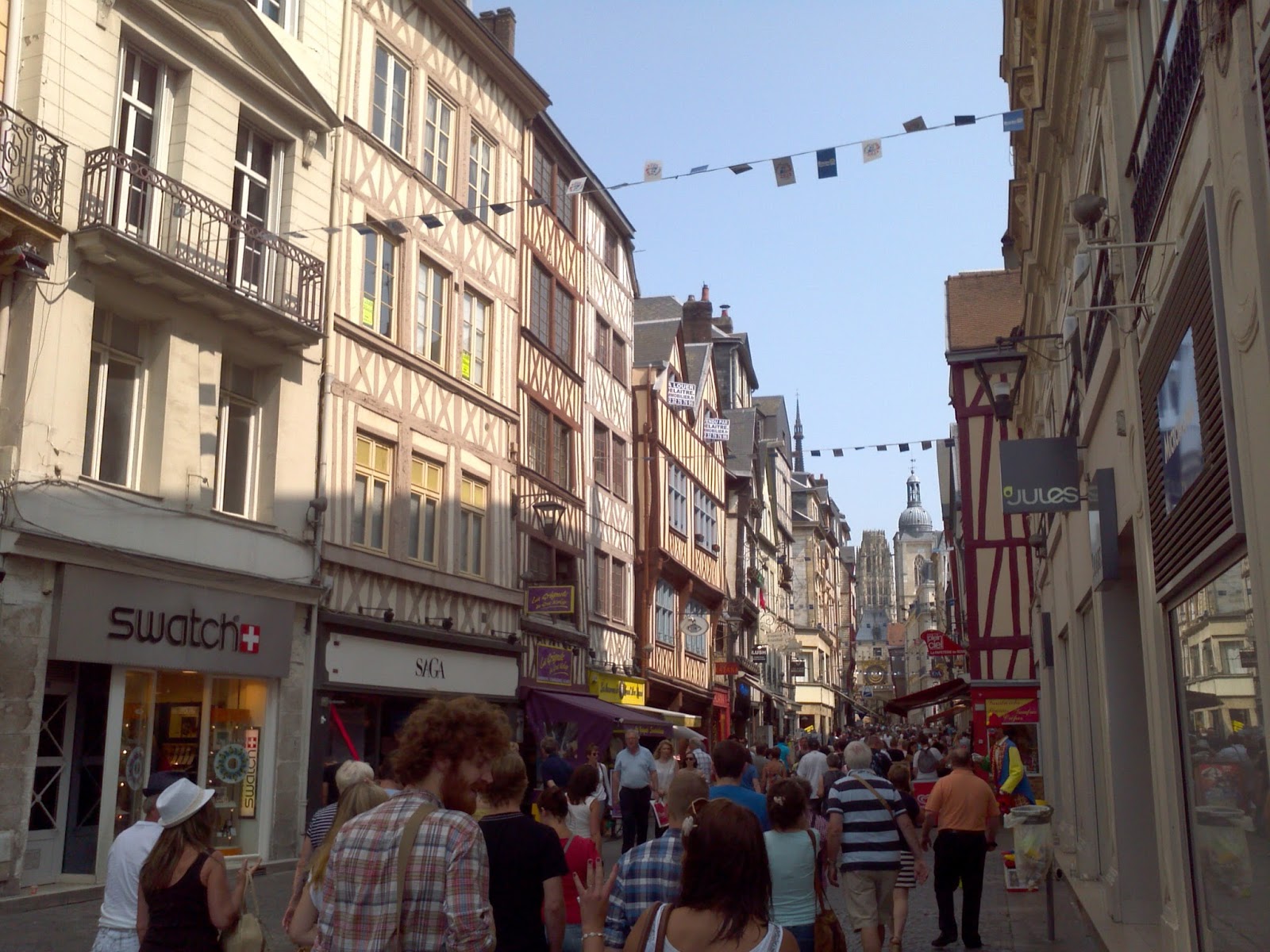
On our way to the cathedral, we passed through many cobblestone streets that have been in place since the Middle Ages.  Several of the buildings were still standing!  Those buildings with overhanging second and third stories were all built before 1520.  The reason for that is because the city banned the building of overhanging levels in that year for three main reasons.  The first is that it was a way to skim on taxes for the building owner because taxes were based on the floor space of the first level.  Many people would build smaller first levels and then expand above to save on their taxes.  The second reason was the concern over fire.  The buildings would have so many higher levels that overhung above the previous floor until the buildings on each side the street would nearly meet each other over the street itself.  This close building allowed fires to travel through a city too quickly to control.  The final reason was to prevent the spread of the plague.  They did not know what cause the plague, but thought that it had something to do with the conditions of the streets.  Because of the overhanging levels, the streets were nearly completely shaded and never dried from rain as well as the emptying of chamber pots out the upper level windows.  It made the streets muddy, smelly, and dangerous to travel.


Rouen is also the location of the execution of Joan of Arc.  As a teenager, she claimed to hear the voices of St. Michael and Margaret who told her that she was assist the king of France to be crowned in the city of Reims.  The problem at the time was that France was in the fighting the British in the Hundred Years war.  Joan led the French army and the king to Reims where he was crowned.  She inspired the French army and turned the tide of the war into the favor of the French after many victories of the British who claimed that the English king was the rightful king of France because of his connection to William the Conqueror, a former Duke of Normandy.

Joan was captured and sold to the English by those loyal to the Duke of Burgundy who was an ally of the English.  King Charles VII of France was given the opportunity to ransom her, but did not do so.  Some claim that the French monarchy was too poor to pay the ransom price while others believe that Charles chose not to pay because of her claim that she received messages from above to fight the English and Charles was ready to negotiate peace.

Joan was tried, convicted, and sentences to life in prison in the city of Rouen for life by the British.  Joan agreed to the terms that included the rule that she never wear men's clothing or armor again.  While imprisoned, she was seen wearing armor so the French tried her for heresy and sentenced her to burning at the stake for witchcraft.  In 1432, she was executed and her ashes put into the Seine.  Twenty-five years later, Charles VII championed her name and with 1600 testimonials had her conviction of heresy overthrown and had her made a martyr.  Some believe that this was a political move to prevent people from questioning his coronation because she was convicted as a witch and she was the reason he made it to Reims for coronation.  In the late 19th century, the French used Joan as a rallying symbol after demoralizing losses to the Prussians.  She became a saint in 1920.

In 1978, the city of Rouen constructed a church near the location of her execution and dedicated it to her.  The Church of Sainte Jeanne d'Arc (below) was a modern construction with an eye toward the history of the city.  The small garden on the right side is the location of her execution near the market square.  The shape of the church had many symbols.  The pointed roof was as if flames, the interior of the church was built with chessnut timber that resembles the Viking longboats of the early settlers.  In addition, the church is triangular in shape with one wall nearly completed filled with stain glass windows.  The windows, from the 16 century, came from a cathedral along the Seine on the outskirts of Rouen.  During World War II, the windows were removed to protect them from damage.  Unfortunately, the cathedral was completely destroyed during the war, leaving the windows without a home until the construction of this church.


Our walk through the city was several hours long and filled with more stories than I can share here.  It was an interesting mixture of ancient, medieval, and modern construction and history.

Tomorrow we wake early to visit the beaches of Normandy - the location of the D-Day invasion of World War II.  We have a bit of a hike to get there, so we are heading to sleep earlier. :)

Friday, July 12, 2013

Day 3 - Giverny and Vernon

We sailed along the Seine through the night and woke this morning docked at the city of Vernon in the region of Normandy.  Our day began with a visit to the home of Claude Monet in Giverny.  Looking for an area in the country that he could use to inspire his landscapes, Monet discovered Giverny in 1883 while traveling through Normandy by train.

The Seine River was the inspiration for many of the early impressionist paintings and Monet was traveling 50 miles from Paris for painting before he moved his family to Giverny by renting a farmhouse that he was later able to purchase after his paintings began to sell successfully.  Those sales were mostly sent to the United States and were so successful that he was able to purchase the farmhouse and the surrounding three acres for the price of four of his paintings by the time he was in his 50s.

Monet would paint and repaint the same scenes at different times of day and different days of the year.  His focus was on the light surrounding the objects rather than the objects themselves.  This became clear to collectors with his work known at the Haystacks - the location of which is now a parking lot.  They waited to tell us that until we were standing on that parking lot, so it was a bit sad.

When he began to sell his paintings successfully, he bought additional acres near his home and began to design and construct his own gardens.  There are two sections of gardens on his land - one organized into room-like areas and the other a water garden with water lilies and bamboo trees.  Monet held a tight hold of control over his gardens and was known to meet with his head gardener three times a day to inspect portions.  The water garden is where Monet painted his famous Water Lilies.  The water lilies were so important to him that he had one gardener on staff that was required to  spend each morning washing the water lilies from the dust that had settled on them from the dirt road.  Finally, Monet was so irritated with the dirt road that he volunteered to pay for the town to pave the road!


Monet designed the gardens to be a living work of art by choosing flowers with colors that contrasted and complimented each other.  The garden closer to the house was divided into "rooms" by large manicure shrubs.  Within each room, the flowers planted were of the same colors - white, red, violet, yellow, and even black!  The black flowers were a striking color that had tinges of red and deep violet depending on how the light hit the plants.  Laura and I enjoyed the quiet of those gardens after the crowds of the water garden.  We took a few minutes to sit on a bench in the quiet before moving on with the rest of the tour.


When we returned from Giverny, Laura and I took a brief water color class on the ship!!  Laura painted a cliff and I painted a meadow.  We were definitely beginners, but we had a good time!


After our watercolor class, we decided to take a walk through the little town of Vernon where the ship was docked.  We walked to the 11th century stone church called the Collegale Notre Dame Church.  The style of the church was a mixture of Romanesque and Gothic with spires, stained glass windows, and lantern towers.  It was heavily damaged in World War II, so most of the windows had to be replaced.

Vernon was founded in the 9th century by the Duke of Normandy and is located right on the Seine River.  The town square is less than two blocks from the docks.

While we had dinner, the ship began to travel further along the Seine and we should reach Rouen  by the morning!
 

Thursday, July 11, 2013

Day 2 - Paris

Today we started the morning with a bus tour of Paris.  Our first stop was a terrace that gave us a great view of the Eiffel Tower.


Laura and I with the Eiffel Tower

We crossed several of the bridges over the Seine throughout the tour.  It seemed as if there was a bridge every half mile.  I will need to ask about the total number of bridges in Paris.  Some of them were built to commemorate wars, peaces, and individuals that greatly impacted the city.

We were able to visit the Cathedral of Notre Dame.  This year happens to be the 850th anniversary of its completion after 18 generations of artisans working on it from the foundation to the spires.  Our guide, Vincent, explained that the cathedral was nearly left incomplete due to lack of funds, but that after the publication of the novel, The Hunchback of Notre Dame, they were able to raise the necessary funds.  Some of the stain glass is original to the construction while some windows were placed by Napoleon for his coronation, and still more had to be replaced after World War II when the resistance fought the German occupation.  


We were also able to see the Paris Opera House that inspired The Phantom of the Opera, the National Assembly building, we cruised along the Champs Elysses but did not stop - the shops were way out of out price range.  You name a design, they probably had a shop there.  July 14th is their independence day  and we were able to see the preparations for the massive parade and fireworks that are planning.  For about two miles on either side of the street, they have erected bleacher seating for the invited spectators with flags on the streets and lights in the trees.  The parade will start on the square where many nobles lost their heads (including Marie Antionette) during the revolution.  It will also pass the Arc de Triomphe which commemorates the many victories of Napoleon.

In the afternoon, we visited the Louvre Museum - and Laura actually enjoyed it!!  Of course, we saw the Mona Lisa, but we also saw the final painting of DiVinci.  One of our favorite paintings was the Sacre de emperur Napoleon that depicts the coronation of Napoleon Bonaparte.  In it, you can see the pope standing behind him as Napoleon crowned himself king of France.  All of his many sisters and brothers are also standing around him and they are the only people, besides his mother, that look happy to be there in the picture. :)

We also saw a section of the Parthenon relief sculpture from the top of the entrance that was given as in gratitude to the French for their assistance in repairing and renovating the Parthenon after the ammunition stored there exploded and destroyed much of the structure. 

The Louvre was once a royal castle that was converted into a museum.  The bus parking was underground and when we emerged into the museum, we discovered that we were in what was once the moat.  Some of the base of the towers was visible.

We were fortunate to see a new exhibit that is not even on the regular tours.  It contained artifacts of Islamic art from such places as Saudi Arabia, Jordan, Iran, Pakistan, Syria, and Iraq.  We were not able to see all of the artifacts, but I did manage to find a booklet that gives additional information.


Wednesday, July 10, 2013

Day 1 - Paris

We have arrived!!!  We fell asleep on our delayed flight leaving from New York and we woke in Paris!  We made it quickly through customs and were delivered to the ship in time for a safety drill - got to love those orange vest!

We met nice people from Canada and California during dinner and had just enough time to walk on the sun deck to get a view of the Eiffel Tower while we are docked on the Seine.

Now it is time to get some rest to get ready for out tour of Paris tomorrow! :)


Our view of the Eiffel Tower on the Seine River.


Tuesday, July 9, 2013

Airport Travels

We have been traveling since we left Laura's house at 10 am.  We arrived at BWI Airport two hours early because we expected lines. Ther were no lines and security was very pleasant.  Our flight to New York was less than an hour and, of course, we had no trouble taking a power nap. We arrived at JFK Airport at 4 pm for our 8:55 pm flight!  We found a couple of chairs and we are waiting for our plane to arrive.

Airport waiting can be painful, but we realized as we sit here that we have an unspoken routine for survival. Our plan includes: always bring a book (or two!), lots of gossip magazines, find seats near a window for natural light, drink lots bof water, never walk past the Starbucks, keep snacks at hand, take frequent walks, know where to find the closest restroom, keep an eye on the screens (flights change gates surprisingly), silence is okay (you are about to be stuck in a confined space), be friendly with others that are waiting (you meet the most interesting people that way), people-watching should be an Olympic event, and finally, try to remember that this is vacation and it should be fun!
Laura and I are at JFK waiting for our flight. The flight should be about 8 hours and then we will be in Paris, France!