Thursday, July 5, 2018

From Vilnius, Lithuania to Riga, Latvia

The drive from Vilnius to Riga was 174 miles through country roads. We passed miles of fields including these bright yellow fields of canola.

Halfway on our journey, we made a comfort stop at this peaceful lake to stretch our legs and get some water.

When we reached Riga, we took a walk around Old Town Riga. Entering the old town, we came across the Freedom Monument. Built in 1931, it survived the Soviet era despite multiple attempts to demolish it. In 2001, the traffic circle around it was closed to all but foot traffic and it was restored. Today, it has a guard of honor who stands on site.

Hill of Crosses, Northern Sialiai Region, Lithuania

The mound that once held pagan totems became a holy site for local Christians when the first cross was planted in the 14th century.

It became a pilgrimage site when it became the memorial for those that died in the uprisings against Russia in the 1830s and 1860s.

In the 1960s, the Soviets bulldozed the hill and crosses. Then placed a barbwire fence around it with a guard to stop further planting of crosses. This did not stop them. In the Soviet era, it was a sign of resistance to the totalitarian regime. Today, crosses are planted for many reasons. Some for remembrance of lost loved ones, some are praying for mercy, and others to identify Lithuania as a Christian land.

In 1993, Pope John Paul II visited the site and ordered a cross (foreground) to be planted at the base of the hill. In 2000, a Franciscan monestary was built behind the hill.

Wednesday, July 4, 2018

Trakai Island Castle, Lithuania

Trakai Island Castle, located in Lake Gavle 28 km west of Vilnius, was once the capital a residence of the Grand Dukes of Lithuania and is the only water castle in Eastern Europe. It contains a Ducal Palace with a chapel on top that marks the highest point of the castle and a defensive castle separated from the palace by a moat. It was destroyed in the mid 17th century war with Moscow and left to ruins until it was conserved in 1926 and reconstruction began after World War II.

The barracks for the soldiers, part of the defensive castle.

The interior court yard of the Ducal Palace.

Because of the hundreds of years of neglect, the original furnishing are lost. However, replicas of some items, like the seats of the Grand Duke and Duchess of Lithuania, have been placed throughout the palace.

The moat that once protected the Ducal Palace now contains a walking path.

Vilnius, Lithuania

Where there was once a pagan temple, The Cathedral of St. Stanislaus was built and rebuilt (due to many fires) many times between 1251-1769. The bell tower was once one of the defensive towers of the city. The cathedral was closed by the Soviets in 1950 as part of their policy against religious practices. During that time, it was used as an art gallery and concert hall until it was returned to the Catholics in 1989.

Monday, July 2, 2018

Architecture of Warsaw, Poland

The Royal Palace of Wilanow, Poland

It was a bit of a cool, rainy day... the coldest day of July in Poland anyone we talked with could ever remember! But a bit of rain does not get between me and a palace!

Just south of Warsaw, Wilanow was built by King Jon III Sobieski inspired by his love for his wife, Maria, in the 17th century.  King Jon was most famous for his victory over the Turks in Vienna which stopped the advance of the Ottoman Empire into Europe.

King Jon's library in the palace had a unique organization method. He placed portraits and names of famous authors on the ceiling and placed the books beneath them that matched their speciality. For example, Aristotle marked the philosophy section and Ovid marked the literature section.

King Jon's desk was made of silver, gold, shells, and precious stones and contained several hidden drawers and compartments for him to keep state secrets!

Later owners of the palace opened portions of it to the public in the form of a museum filled with artifacts from their travels. Among the artifacts, was a large collection of Etruscan pottery from Italy. The picture above was only one small sample.

The baroque style of Wilanow and the time of its construction have led to its nickname, Little Varsaille, after the French palace.

Old Town Warsaw, Poland

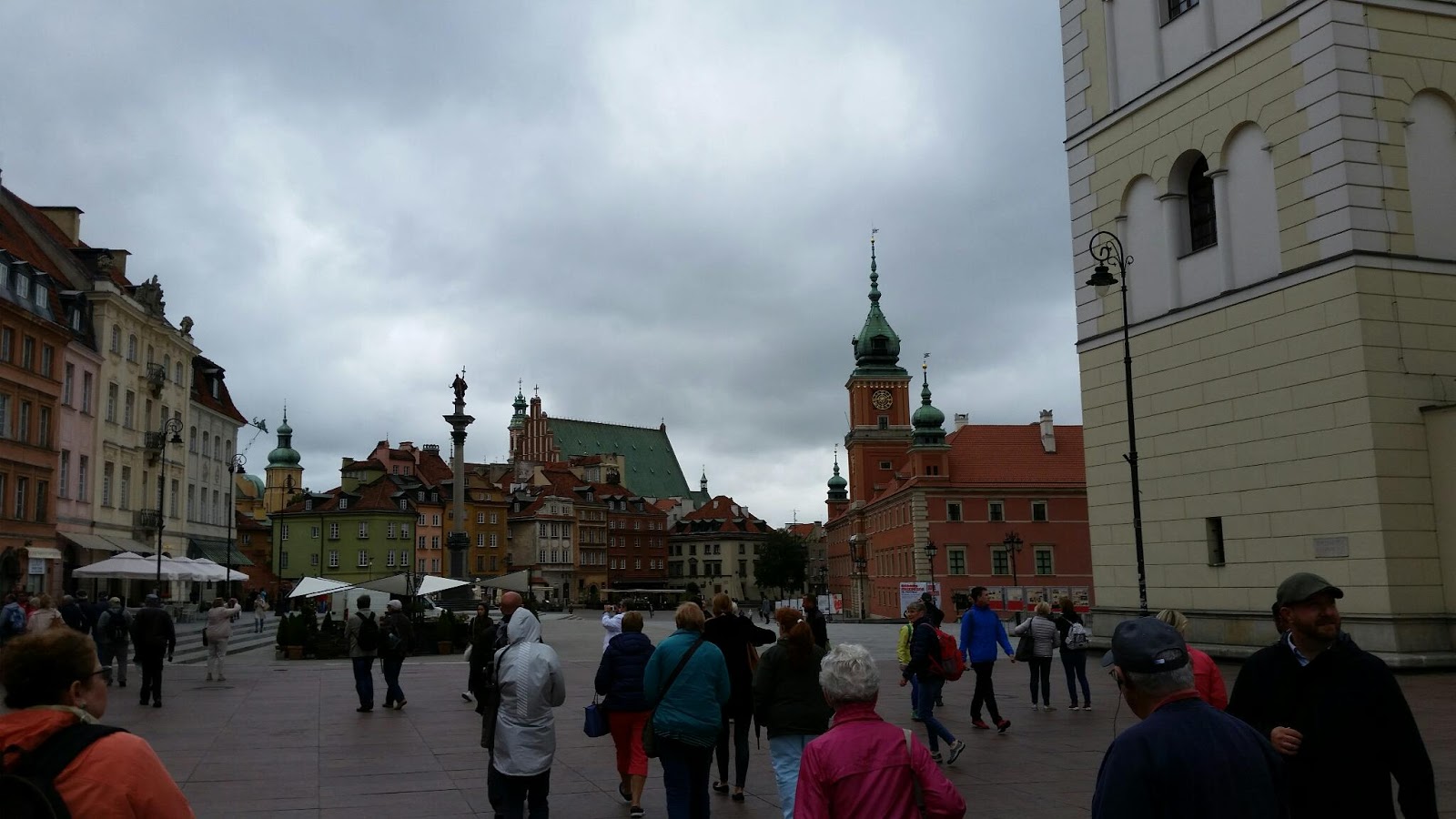
The Castle Square was the residence of the Polish Kings and the seat of Parliament. It along with the rest of the city was destroyed completely by the Nazis in 1944. In response to resistance by the Polish people near the end of the war, the Nazi soldiers placed mines and dynamite throughout the city to leave nothing standing. Warsaw has been reconstructing on the pre-war blueprint since the 1950s.

The Cathedral of St. John the Baptist was originally completed in 1370, but was among the destruction of World War II. Reconstruction was completed in 1956.

The old medieval wall was also reconstructed, including The Babican, the original emtrance. Where a drawbridge and moat were once located, now there is a pathway and garden.