Sunday, July 19, 2015

A Ride Around London

St. James Park Subway Station – Opened in 1860, it is the oldest underground station in the world still in continuous use

Statue of Winston Churchill in Parliament Square facing the Houses of Parliament

King’s/Queen’s Life Guard at the beginning of duty – Does not react or speak to people on the street.  The temperatures were in the upper 90s and that uniform is wool

Love the sign – some did get a bit close and the horse did nip at them and try to drink from water bottles!

Our tour guide for the day, Anthony, was telling us that this training ground for the King’s/Queen’s Life Guards was used in the 2012 Olympics for the Beach Volleyball games!

Statues of the Queen’s parents – King George VI and his consort, Queen Elizabeth.  They are greatly loved by the people of London because of their support and guidance during World War II.  They did not leave their London residence despite the bombings that ravaged the city.

The Queen’s Life Guards marching from their training building up the street to Buckingham Palace for the changing of the guard.  We did not approach the palace at this time due to large crowds and that the changing takes place behind the gates, so only the first row of people get to see them.

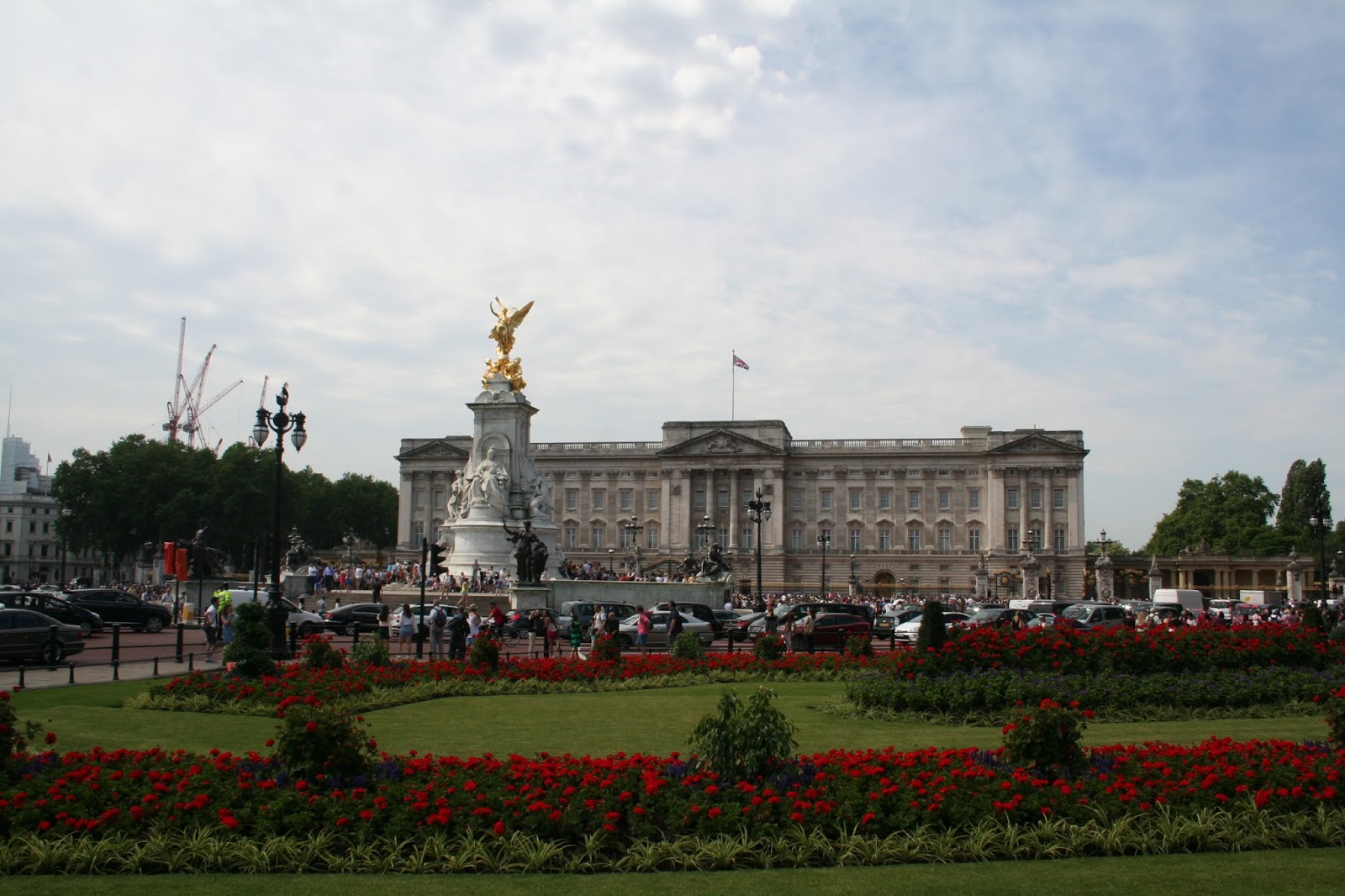
Buckingham Palace and gardens

Statue of Queen Victoria in front of Buckingham Palace. She made this the official residence of the monarch in 1837.

Gift Horse – The latest installment on the fourth pedestal in Trafalgar Square.  It is part of a program that has a rotation of art with varying lengths of presentation.  It is a bronze horse skeleton with an electronic ribbon which displays a live ticker of the London Stock Exchange.  Other pieces included live performances in which artists could access the pedestal for periods of time for live art that included recitation of poetry, singing, live painting, and even people sleeping.

The Gift Horse from the side

Houses of Parliament with Elizabeth Tower and Big Ben (the bell) inside

Churchill in front of Whitehall Palace where he did the work of the government during World War II and facing the Houses of Parliament

Elizabeth Tower with the London Eye in the background

The Tower Bridge and the traffic along the Thames River

View of Elizabeth Tower and Whitehall Street of London from the top level of a big red bus!

The London Eye is 135 meters high with 32 pods holding 25 people each and takes 28 minutes to go all the way around.

Wednesday, July 8, 2015

Wait Five Minutes . . .

Our second day in Edinburgh and we definitely experienced Scottish weather!  Our umbrellas were hanging from our wrists throughout the day as the weather switched back and forth between rain and sun multiple times for short periods of time.


We used our hop-on hop-off bus to see more of the city. We got to see the Queen's yacht, the Britannia. It was decommissioned, so it is open for tours. We got to see the various levels including the Queen's private rooms.

This is the deck outside the Queen's sitting room. 

Our next stop was to visit Holyrood Palace. It is the official residence of the royal family in Edinburgh. We just missed her annual garden party...it was last week! :) It was the home of Mary, Queen of Scots.

This is the forecourt of Holyrood Palace. The fountain in the center is only turned on when a member of the royal family is in residence.

The palace has been renovated and improved many times over the last several hundred years. It was originally an abbey, but the ruins behind me are all that is left.

We ended our day with a walk down King's Mile, a cobblestone street that starts at Edinburgh Castle and ends at Holyrood Palace. It has lots of shops and history.

Tuesday, July 7, 2015

Edinburgh Castle

Yesterday we traveled from London to Edinburgh via train.  Let's just say it was an adventure!  The travel and settling into the hotel took most of the day, so we went to bed early to get a fresh start today.

We walked from the hotel to the center of the city and decided to hop on a tour bus that drove us throughout the city where I got lots of great pictures from the open top deck! I will share those when we get home.

We also decided to visit Edinburgh Castle which was on top of a mountain made from volcanic rock. It was quite the climb!

Edinburgh Castle from Princes Street

The entrance to Edinburgh Castle

The view of the city from the canons along the wall of Edinburgh Castle

Sunday, July 5, 2015

310 Miles Across Southern England

Today was jam-packed with three major stops on a 310 round trip through the country - from as far west as the edge of Wales and as far east as 20 miles from the English Channel.

Our first stop was Windsor Castle!  The oldest and largest continuous royal castle residence in the world!  The Queen was not in today as the Christening of Princess Charlotte was occurring in Sandringham further to the north, but there was still much to see!  Originally built by William the Conqueror at the end of the 11th century and expanded by kings throughout the following 900+ years.

No pictures were allowed to be taken  inside, but we were able to see the Throne Room where the knighting ceremonies take place, the state rooms included many portraits including the Queen's official state portrait.  It is also the burial place of Queen Victoria and Prince Albert, King Henry VIII and Jane Seymour (his only wife buried with him), and King Edward VIII and Wallis Simpson.

The city around the castle is a lovely, if expensive place to live.  It pays (or costs) to live so close to the Queen.  Eton is also within the city - where Prince William and Prince Harry went to school.

The courtyard within the castle walls.  The Queen's residence is the tower to the right.

Laura and I just inside the King Henry VIII Gate.  This portion of the castle was built at his order and he loved the castle so much, he chose to be buried there rather than Westminster Abbey where kings were buried at that time.

The moat was never filled with water.  Instead, it is the location of lovely gardens.  Again, the Queen's residence is in the tower in the back of the picture.

Our next stop was in the Salisbury Plains to visit Stonehenge!  It was believed to have been built around 3000 BC and had many uses, but it original purpose is still not yet known.  Excavation of the site is continuing to this day and they have not uncovered even half of the area that is believed to be part of the site.  The stones are not just stacked, but are interlocking to complete the arches.  They have found that the stones perfectly align with the rise and/or fall of the sun during the summer and winter solstice.

On our drive, we ran into rain and feared that our time would be cut short, but the sun came out and lovely breeze kept us cool until we returned to the bus when the rains returned!


Our final stop on the tour today was to the two of Bath to visit the Roman Baths.  The town was unknowingly built on the ruins of a Roman Temple from nearly 2000 years ago.  The waters of Bath come from hot springs and are believed to have healing powers.  At the end of the tour, we were invited to drink from the fountain.  The water was as warm as a cup of tea and was not bad to taste. We were allowed to take pictures inside, so there will be more coming later! :)


We left London at 8:00 AM and returned to the hotel with wonderful service from the guides (who dropped us off at the hotel doors rather than the bus station because they were passing our hotel anyway!) and we found a surprise!  Mom arranged a birthday gift  to be left in the hotel room when I returned!  Chocolate cake was a wonderful way to end the day!


Saturday, July 4, 2015

The "Original" London Tour

Today we took the hop-on, hop-off bus known as the "Original London Tour," on a loop through the city!  Our tour began at Trafalgar Square and looped throughout between Westminster and London City.  We saw so many sites for which I took lots of notes and took many pictures with my camera, so those will have to wait until we get home to be uploaded.  We did manage to grab a few shots to post between my tablet and Laura's phone. :)  The loop took more than two hours to complete!

Our view of the Tower Bridge as we crossed the Thames River on Waterloo Bridge.

Laura with one of the tour buses behind her.

On the right side of the street - more than one block in length - is the famous Harrod's store.  We took a walk inside, but there was too much going on at once!

I took a walk through Kensington Gardens and caught a glimpse of Kensington Palace!

This marble arch is known as the Queen's Arch.  It was originally meant to be the entrance to Buckingham Palace, but there are several stories about why Queen Victoria had it removed and placed as an entrance to Hyde Park.  My favorite story was that she purposely had a carriage built that was too wide to fit through the center arch, leaving them no choice! :)

While walking through Hyde Park, I found a small garden area with a fountain.  It was a lovely place to sit and forget that I was in the middle of a city filled with nine million people!

Panoramic view of a garden in Hyde Park

One last glimpse of Hyde Park before returning to the city.

Wellington Square contains commemorations in honor of the Duke of Wellington who led the British in their defeat of Napoleon in the early 19th Century.

The Wellington Arch  to commemorate the peace brought to Europe after the defeat of Napoleon.  The four-horse chariot at the top is to celebrate the victory of peace, not war.

At each crosswalk, there is a message on the road to remind pedestrians from which direction the cars are coming at them.  I found this very helpful!!! :)  They drive on the left side of the road and there are many roundabouts, so it can be tricky to determine where to look for cars!


Laura took this great shot as we were crossing over the Tower Bridge.

We had a full day, so we are resting for our second adventure out of the city early tomorrow morning!

Friday, July 3, 2015

Two Churches and a Castle

Having successfully navigated a combination of the Tube and Big Red Bus system yesterday, we decided to use our new-found knowledge and begin our day by independently traveling across London to reach Westminster Abbey before the crowds.  We rode the bus from Olympia to Trafalgar Square and walked to the Abbey without having to do any backtracking!  It is amazing what a good map makes possible!

We arrived to the Abbey before it opened and only had a short line, so we were not crowded as we explored the inside.  Due to  restrictions on photography, I was not able to take pictures inside, which worked out well, because it gave me time to really appreciate what I was seeing.


Westminster Abbey

Little is known about when the earliest parts of the Abbey were first constructed, but records show that the Abbey was the home of a group of monks around 960 AD.  Most of the earliest remaining portions of the Abbey are below ground as part of the foundations.  Most of the visible portions were built under the order of King Henry III between 1245 and 1272 AD.

During the reign of King Henry VIII, the monastic abbey was dissolved with the Reformation.  However, it was re-founded by Queen Elizabeth I under royal control - answering to neither the Church of England or the Roman Catholic Church.  In fact, Queen Elizabeth I is buried in the Abbey in the same chamber as her sister, Queen Mary despite their differences in religious beliefs.  Their combined tombs was meant to bring together their two faiths.

By the late 18th century, it became a place of burial for many people.  There are more than 3000 people buried or commemorated within the walls of the Abbey and there are nearly 600 tombs, monuments, and memorials.  Among them include Mary Queen of Scots, Henry V, Edward the Confessor, Thomas Hardy, and Chaucer.  

The Abbey also hosts happier events including the 2011 wedding of Prince William and Catherine Middleton and has been the location for the coronation of every monarch of Great Britain since Henry IV in the 14th century.

We left Westminster Abbey and walked through Parliament Square located between the Abbey and the Houses of Parliament.  This park--like area contains a green as well as statues throughout that celebrate men who have worked for justice both in Great Britain and around the world. Among the statues was Winston Churchill, Gandhi, Nelson Mandela, and Abraham Lincoln.


Parliament Square

Our next stop was to St. Paul's Cathedral in London City.  It is the 5th one built on the site since 604 AD when the Romans were still in control of the city.  This cathedral was built after the great fire of London in 1666 burned the previous church to the ground.  It is considered the people's cathedral while Westminster Abbey is considered the royal cathedral.   The cathedral, finished between 1675-1711, contains a double dome top with elaborate details that include glass mosaics throughout the interior rather than stain glass windows.

During World War II, it was heavily bombed by the Germans, but remained standing - many people seeing that as a sign of hope.  One bomb got stuck within the dome, but did not explode!  After World War II, one chapel of the cathedral was rebuilt with funds raised by the people of Great Britain and dedicated to become the American Memorial Chapel to commemorate the 28,000 Americans killed during the war in service of protecting Great Britain.  There is a 500-page roll of honor that is turned one page a day behind the high alter with all of their names listed.  The cathedral is also where Prince Charles and Princess Diana were married in 1981.


This is the best angle that I could get with the tablet of St. Paul's Cathedral.

Out last stop of the day was to the Tower of London  - although famous as a prison where such historical figures as Anne Boleyn were imprisoned and executed, it was originally a Norman stronghold built by William the Conqueror by 1100 AD.  It was built partially using the existing Roman walls from about 200 AD when the city was part of the Roman Empire and known as Londonium.

It was expanded as a royal fortified castle by the reign of Richard the Lionheart in the late 12th century.  During the reign of Edward I (1272-130 AD), it became more a military fortification rather than a residence as well as a place for storing official documents and valuables - from wealth to prisoners.  It is currently the location of the vault holding the Crown Jewels which were one display for public viewing.


Me in front of the entrance to the vault of Crown Jewels.


Guards throughout the Tower Castle included ceremonial guards (like those above).

I asked my travel companions what they learned today that either surprised them or stuck with them as we sat down for a late dinner.  They said that it was amazing how simple some of the 16th century king's tombs were compared to the lesser nobles buried in Westminster Abbey in the 18th century.  Very different styles!  Also, that the Tower of London was not just a single tower, but an actual fortified castle with many buildings within its walls.  Many towers can be found with various names including Beaucamp Tower, Bloody Tower, White Tower, and Cradle Tower.  What was also surprising was that no photographs could be taken of the Crown Jewels!  And finally, we got to sit for a bit in the same spot from which Queen Elizabeth II witnessed the wedding of William and Kate!  (I will let you try to figure out who learned what!)